23rd September, 2026
The Definition Of Risk In Health And Safety (With Workplace Examples)
In health and safety, a risk is the chance that somebody could be harmed. A risk calculates how likely it is that someone will be hurt, and how severely. In this post, we look at the definition of risk in health and safety, and some common examples of workplace risks.

At work, risk assessment is a legal requirement, so if you are going to carry out health and safety responsibilities as an employer, or as an employee, then you need to know what a risk is.
Knowing what risks you face at work is critical to health and safety.

Because controlling risks is the only way to stop people from getting hurt.
The definition of a risk
In health and safety, a risk is the chance that somebody could be harmed and how serious that harm could be.
Risk levels can range from low to high.
So a risk isn't just something that could hurt you; risk is a calculation of how likely that thing will hurt you and how severely it could hurt you. The thing that could hurt you is known as a hazard.
Risks can be to your health, or to your safety (or both).
Safety risk examples:
- Crushing in pinch points
- Entanglement with rotating parts
- Entrapment
- Contact with moving equipment
- Slips
- Trips
- Falls
- Drowning
- Oxygen deprivation
- Smoke inhalation
- Electric shock
- Fire
- Explosion
- Violence
Health risk examples:
- Asthma
- Cancer
- Dermatitis
- Hand-arm vibration syndrome (HAVS)
- Lung conditions
- Deafness
- Reproductive issues
- Organ damage
- Stress

Health risks tend to happen gradually from long-term exposure to a hazard, rather than through a single workplace accident.
Examples of workplace risks
Now we know the definition of a risk, and what a health and safety risk means. Let's look at some common examples of risks that might be present in your workplace.
Working at height risk examples
For our first example of risk, we picked an activity hazard - working at height. Working at height isn't a risk itself; it's a hazard, the source of the risk.
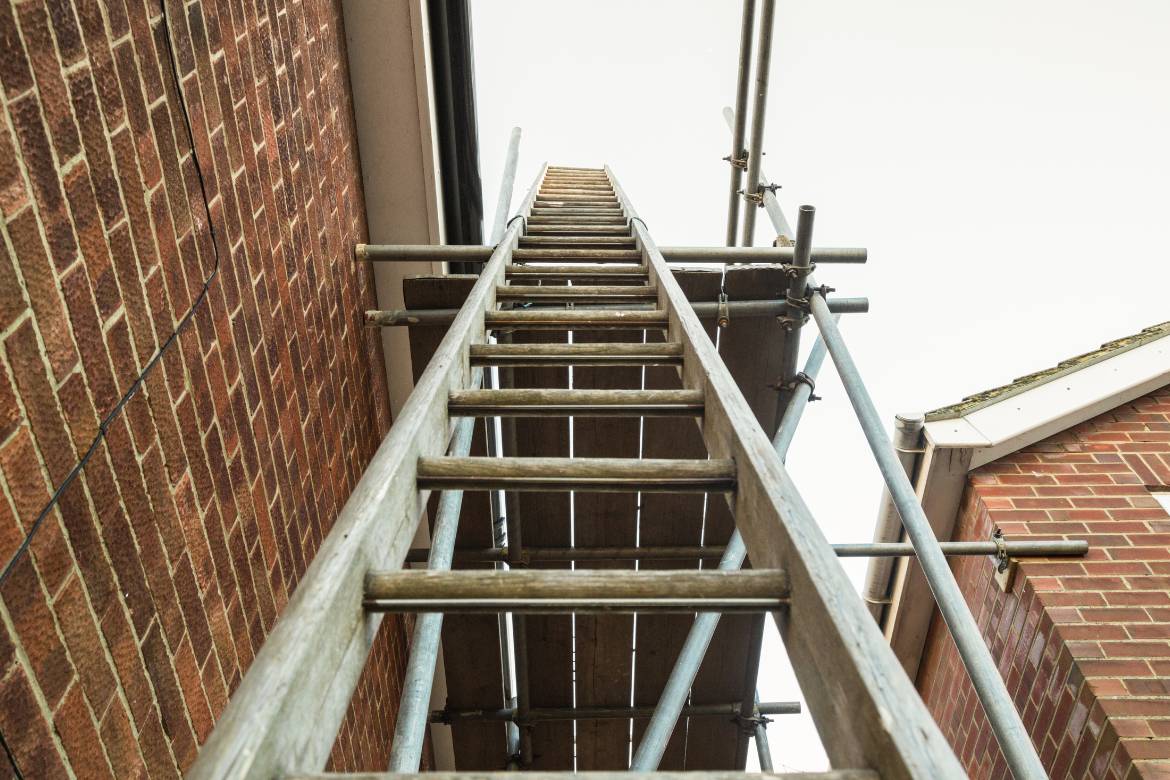
Here are some examples of work at height risks:
- Falls from the edge of the platform
- Falls through fragile materials
- Falls of tools
- Falls of materials
- Overturning equipment
- Collapse of equipment
- Struck by lightning
- Falls of trespassers or children through unauthorised access
One of the main risks associated with working at height is falls from height.
When you work at height, there is a risk that you might fall, but how do we calculate whether this risk is high, medium, or low? Well, with no controls in place, if there is no barrier or lanyard to stop you from falling, the likelihood of falling is high. And the consequences could be pretty severe too, because falls from height can be fatal.
If you were to look at the likelihood x severity for this on a risk matrix, you would score pretty highly, so we can consider the risk to be high.
But if you did put some controls in place, you could reduce the risk to a more reasonable level. If you put some barriers in place, you can reduce the likelihood of a fall occurring. Or, if you use a fall arrest system, you can reduce the consequences of a fall, resulting in less severe injuries.
By choosing suitable control measures, the residual risk can be medium or even low.
Hazardous substances risk examples
Hazardous substances are something we come across in our everyday lives, like cleaning solutions, paints, fumes, and dust. So it's no surprise that you will find hazardous substances in most workplaces.

Hazardous substances come under the COSHH regulations, although some, like asbestos, have their own regulations.
Different types of substances will create different types of risks. Some substances can be bad for your lungs if inhaled, others might cause skin irritation or burns, and others could kill you if they are accidentally ingested.
Here are some examples of hazardous substance risks:
- Skin irritation
- Dermatitis
- Chemical burns
- Eye irritation
- Asthma
- Chronic lung conditions
- Cancer
- Reproductive issues
- Organ damage
- Nausea
- Dizziness
- Unconsciousness
Without control measures, a substance could be nearly certain to put you in the hospital; just a small amount in the air could send you unconscious in moments.
But just like our earlier examples, you can reduce the risks with suitable controls for hazardous substances.
You might substitute a toxic substance for a non-toxic substance, reducing the severity of exposure. Or you might use an enclosure to reduce the likelihood of exposure. Or you might use respiratory protective equipment to filter out harmful substances in the air.
Using a drill risk examples
We often use tools and equipment at work to get things done. We might use a drill to drill through metal, wood, or even concrete.

Using a drill might not seem like a high-risk item, but you could drill into services like electricity, water, or gas, you could get entangled with rotating parts, and long-term exposure to noise and vibration can have a devastating impact on your health.
Here are some examples of drill risks:
- Entanglement with rotating parts
- Cuts and abrasions
- Projection of materials
- Electric shock
- Noise exposure
- Vibration exposure
- Contact with hot surfaces
- Dust exposure
As we know by now, these risks can (and should be) controlled, so that we reduce the likelihood of harm occurring and the severity of the harm that could occur.
For example, you can check for services before drilling into a wall to reduce the likelihood of contact, and you can isolate the services to reduce the severity of contact if it does occur. You can wear appropriate PPE like goggles (to protect your eyes), gloves (to protect your skin), a dust mask (to protect your lungs), and hearing protection (to protect your ears).
Ready to create your own risk assessments? Before you can assess risks, you need to identify the hazards in your workplace. Hazards can create multiple risks, and you can use our free risk assessment calculator to find out the risk level.


This article was written by Emma at HASpod. Emma has over 10 years experience in health and safety and BSc (Hons) Construction Management. She is NEBOSH qualified and Tech IOSH.
Better health and safety...
We are here to help you and your business put safety in everything.
Learn MoreRecent posts like this...
The Definition Of Risk In Health And Safety (With Workplace Examples)
In health and safety, a risk is the chance that somebody could be harmed. A risk calculates how likely it is that someone will be hurt, and how severely. In this post, we look at the definition of risk in health and safety, and some common examples of workplace risks.
Read Post
What Does LOLER Stand For?
In health and safety, LOLER stands for the Lifting Operations and Lifting Equipment Regulations. This is a set of legal requirements surrounding lifting operations and the equipment used to carry them out. These regulations are often referred to as LOLER for short. But what is LOLER?
Read Post
The A-Z Of Health And Safety Acronyms And Abbreviations
In health and safety, every other sentence seems to contain an acronym or abbreviation. Some words and phrases are just easier to remember if you shorten them down to a few letters. But if you're lost in the lingo when asked for your RAMS on the ACMs required in the CDM CPP, this guide will help.
Read Post