20th May, 2026
The Simple Construction Risk Assessment Pocket Guide (+Free Template)
If you work in construction, you'll need to write risk assessments. It's a legal requirement and will often be required before you start work on a new project. In this guide, you can follow along with our free template, from identifying hazards to assessing and controlling the risks.

Most types of risk assessment should follow the HSE's five steps to risk assessment, including construction risk assessments.

Here's how you can apply the five steps to risk assessment for construction work.
Free template
To follow along with this guide, you can download the free blank risk assessment template and fill it in as we go through each step.
In the first section of the template, you'll add your project details and the construction activity you are assessing, for example, decorating, roofing, underground drainage, or a wall demolition.

Because each hazard can create many risks, if this is the first time you are doing a risk assessment, you might find it easier to go through the guide for each hazard and then come back to the start for the next hazard.

Ok, let's get started by identifying hazards.
Identify construction hazards
The first step of the 5 steps to risk assessment is to identify the hazards involved in your work activity. And that's the first section of the risk assessment template, hazard identification.

In this section, you will list down the hazards involved with your construction activity.
Construction is a high-hazard industry, and hazards you might come across in your work activities include working at height, confined spaces, vibration, machinery, work near water, equipment, hot work, lone work, lifting operations, excavations, and manual handling.
The equipment you use might also create a hazard, such as ladders, scaffolding, power tools, and blades.
You'll probably also come across hazardous substances in your work, like concrete, asbestos, cement, silica dust, wood dust, paint, varnish, chemicals, flammable liquids, and fuels.
And the weather can also be a hazard when you are working outside, so make sure you consider the conditions you will be working in.

Don't make the mistake of listing risks at this stage; a hazard is not a risk, so just think about the things that could hurt people - we will look at reducing risk later.
For more hazards, see our list of hazard examples.
Once you have a list of hazards, you can start to think about how people might be hurt by them.
Who might be harmed?
The next step in your construction risk assessment is to decide who might be harmed, and how.
The first person that might be harmed by a hazard is the person carrying out the work, or the operative, but construction sites are busy places, and other people could get hurt too.
- The worker or operators
- Adjacent workers
- Particular groups of workers
- All workers
- Visitors
- Other occupants
- Members of the public
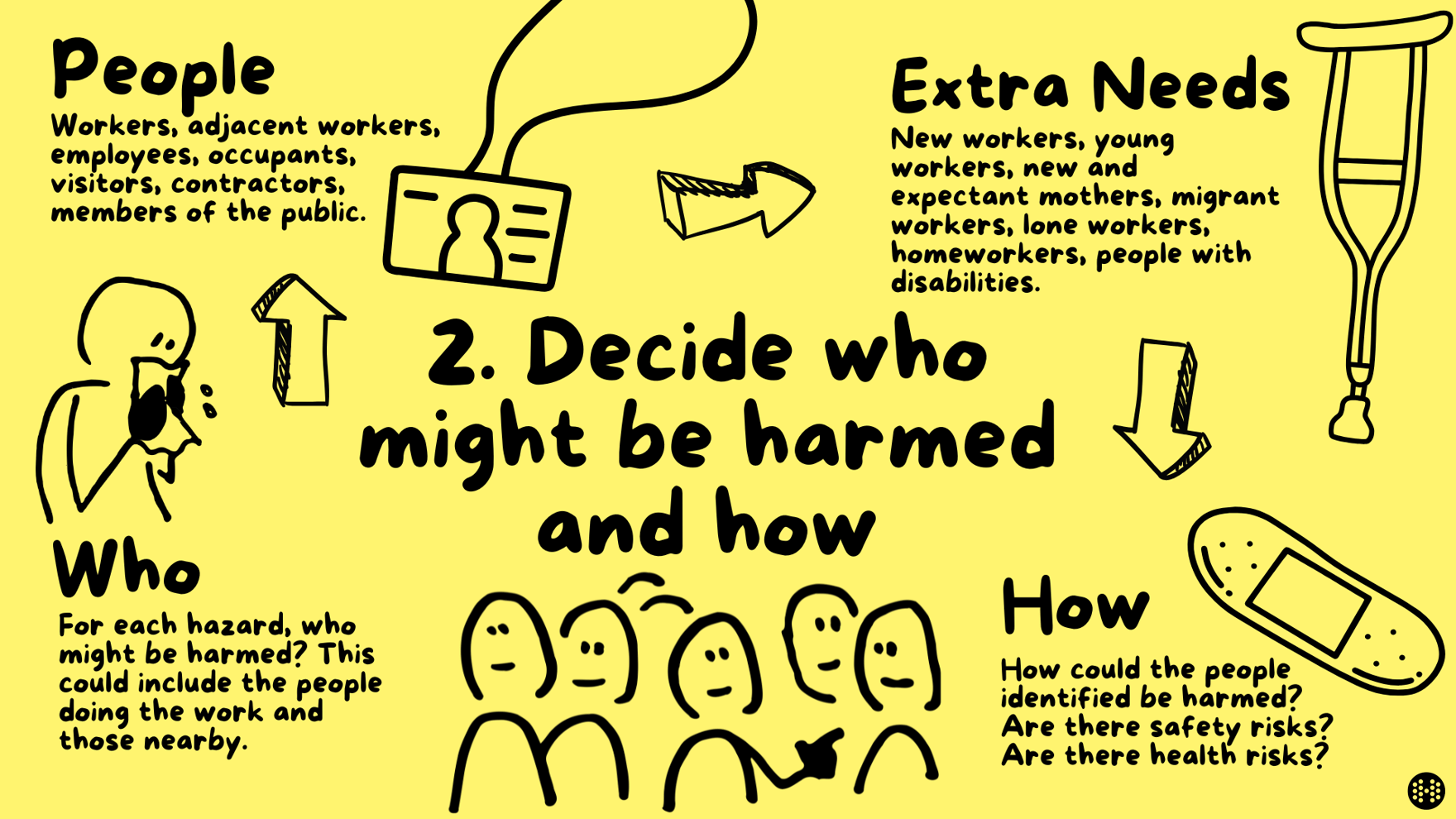
Will other workers be nearby who could be injured by the hazard? What about other workers on the site? Will there be delivery drivers and other visitors who could be exposed to the hazard? Is the site occupied by other people, and could they be in danger? And finally, what about members of the public? Could they get hurt either on or off the site?
Assess the risks and decide on precautions
Now that you have identified the hazards and considered who might be harmed by them, you can start to measure the risk.

A risk is the chance that somebody might be harmed by the hazard. But how do you know if the risk is low, medium, or high?
Risk = Likelihood x Severity
How likely is it that people could be harmed by the hazard, and how serious could that harm be? It's common to use a risk matrix to work out the overall risk level, based on the likelihood and severity of harm.
For example, on a construction site, you could be likely to come into contact with moving machinery, and the severity for pedestrians could be death, which would give you a high risk level.
Hopefully, you already have some controls in place, and your risk level isn't that high, but during your risk assessment, you can think about how to reduce the risk to a safe level.

You can enter your risks in the controls section of the free risk assessment template.
If you need help calculating risk, use the free risk assessment calculator to get your risks in order.
Next, you need to decide on precautions (or control measures) to reduce that risk level, because you don't want pedestrians to be likely to die on your construction site!
You can write down the controls in the column next to the risk.
Some good construction traffic management practices would be to keep pedestrians away from vehicles and machinery. So you could put in place separate routes for vehicles, with a one-way system and designated crossing points, to reduce the likelihood of contact with moving machinery. You could also add physical barriers and enforce a speed limit to reduce the severity of possible contact.
By reducing the likelihood and severity of harm, you can reduce the risk to a more acceptable level. As low as is reasonably practicable.

Now that you have evaluated the risks, you can record the overall risk level next to the hazard back in the hazard identification section.
Look at the risks for all of the hazards you identified earlier, and see what control measures you need to make your construction site safer.
Write your risk assessment
If you are already using the free blank risk assessment template, you are probably already recording your findings, and that's great because it's actually a legal requirement if you have five or more employees, and step 4 of the 5 steps to risk assessment.

Even if you have fewer than five employees, keeping a written record of your risk assessment will make it easier to:
- Communicate hazards
- Get people to comply with health and safety rules
- Share information with clients
- Share information with your team
- Prove you are complying with the law
- Gain health and safety accreditations
- Win more work
Review your risk assessment
Ok, you don't need to review your construction risk assessment right now, you're only just writing it. But it's worth noting that once you have finished your risk assessment, it's not finished forever.
Things change, especially on construction projects. Your sites change, your team changes, the activities you do change, and the equipment, tools, materials, and substances you use change.
And those changes could mean that new hazards are introduced, and new risks created.

So when things change, you will need to review your risk assessment to check if you will need to introduce or update any control measures to keep people safe on your building sites.
Need help with your risk assessments? We have a large library of risk assessment templates that you can edit and use for your business activities.


This article was written by Emma at HASpod. Emma has over 10 years experience in health and safety and BSc (Hons) Construction Management. She is NEBOSH qualified and Tech IOSH.
Need health and safety documents?
Search hundreds of health and safety documents ready to edit and download for your construction projects.
Find DocumentsRecent posts like this...
The Health And Safety Documents You Need In Construction (+5 Free Templates)
Do you have all the necessary documents for your construction sites? With so many health and safety requirements to cover, in this blog post, we look at the 11 types of essential health and safety documents you'll need to run a construction site.
Read Post
What Are Pinch Point Hazards? 6 Examples And How To Spot Them
Pinch point hazards are common in many workplaces, and especially in construction and manufacturing. A pinch might not sound too severe, but pinch points can cause life-changing injuries, and in the worst cases, they can be fatal. But what is a pinch point? And how can you spot these hazards?
Read Post
24 Free Construction Safety Posters For Your Building Sites
Need to remind workers to sign in, lock up, or wear their PPE? These 24 free construction safety posters can be downloaded, printed, and displayed on your site to help your team stay safe throughout your project.
Read Post